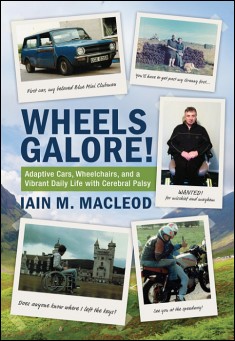
Wheels Galore! Adaptive Cars, Wheelchairs, and a Vibrant Daily Life with Cerebral Palsy
by
Free ebook download: Wheels Galore! Adaptive Cars, Wheelchairs, and a Vibrant Daily Life with Cerebral Palsy by , legally licensed and available in PDF, and ePub formats.
A Vibrant Daily Life with Cerebral Palsy, is a memoir of my life as a disabled wheelchair user and my sheer determination to overcome all obstacles. Free ebook download.
Also available as an Audiobook
A memoir of my life as a disabled wheelchair user and my sheer determination to overcome all obstacles. From early childhood into my teen years and adulthood, I was not going to let my disability get in the way of my ambitions or goals. Usually that was in the form of going as fast as I could on anything with wheels — my various wheelchairs, my tricycle, my battery car, and several wheelchair-adapted cars ever since! In this book I describe all the amusing situations I’ve found myself in along the way, and how I’ve educated myself up to PhD standard. I to inspire children and adults of any age to rise above the perceived limitations of disability and live life their way with grace, guts, and gusto!
Excerpt:
It was the early 1970s, and my mum and sister Eileen and I I were making our way to Stornoway for five glorious weeks of summertime at Granny’s house during the school holidays.
The waves crashed against the ferry’s bow as it sailed across the Minch, a vast body of water, from Ullapool to Stornoway, an island that lies off the West Coast of Scotland.
We usually flew from Inverness to Stornoway on a Viscount plane, usually about a forty-minute flight, but this time we took the car ferry, a three-hour journey across the sixty-mile stretch of water to the island. We typically only made the journey by ferry when Dad was with us, as he had the car.
The ferry was, and still is, a lifeline to the island, and everything is transported by ferry—cars, lorries, and caravans, and there were foot passengers as well! Motorhomes were not all the rage back then as they are today, but I’m sure lots of them pile onto the ferries nowadays.
When you are in a wheelchair, you get special treatment on public transport. People try to help you and make things as comfortable as possible, but there’s no getting around it: the whole process is undignified if you use a wheelchair.
You learn to cope with whatever situation you come across, and keep a sense of humour about it. Might as well grin and bear it, and get on with life!
Modern ferries have lifts, which means wheelchair users no longer have to stay in their vehicle. Besides inhaling all that good fresh air, the wind in your face is so wonderful.
The journey by plane was a much more enjoyable experience than a long car trip combined with a ferry crossing.
It took about three-quarters of an hour to get to Inverness Airport in our blue Ford Cortina, but when you’re a child, it feels like it takes forever. Every child knows the refrain, “Are we there yet?” after a mere ten minutes into the journey!
Something I remember quite vividly as we were driving out of Elgin, heading for Inverness Airport, was a house that had tears painted below two of the windows, and my sister and I would say, “There’s the tiny-tears house!”
But even a plane trip, with all its promise of excitement and adventure, was fraught with indignities. When you’re in a wheelchair, you’re first on the plane and last off. Sounds like privileged treatment, doesn’t it? Well, that’s not always the case, and most of the time it makes you feel different from everyone else because, let’s face it, you are being treated differently. It was a cumbersome ordeal.
First, I was strapped into a narrow metal chair with caster-type wheels at the back. The chair was narrow enough to be wheeled between the center aisle of the airplane cabin. Upon being strapped into the chair, it was tipped back, and I was wheeled to the aircraft.
Sometimes I was lifted onto a van and driven to the aircraft.
At the foot of the staircase, I was lifted by two male employees and wheeled to my seat. I could transfer from the chair to the seat on my own.
When we were finally all onboard the plane and settled in, my mother and sister and I had to wait for the other passengers to board the aircraft, usually five or ten minutes later.
Once everyone was seated, and the flight attendants went through the emergency evacuation procedures, the plane taxied down the runway, and away we went.
I loved the feeling of surging power as a plane powerfully accelerated down the runway before taking off into the sky.
Another thing I loved about planes was the smell when I first went inside them, a combination of recycled cabin air and air drawn in form outside the aircraft—a cocktail of chemicals, but for some inexplicable reason, I loved it!
Ascending into the sky, I could see the toy cars driving to Inverness or making their way further north. It was fun looking at doll houses below and fields with their undistinguishable crops.
Flying west, I could see the miniature landscape below, and I imagined the people going about their daily lives unaware that I was taking in the beauty of their land, their little piece of Scotland, from thousands of feet above them.
After about twenty minutes, I looked down and saw water below. Then, we were over land again, and it was fascinating to see the houses increasing in size as the plane descended to the runway. Moments later the plane came to a jarring, bracing halt near the airport terminal.
The procedure of unloading me from the plane was reversed from boarding the aircraft at Inverness.
Here we go again, I would think with a sigh as I settled in to wait. Instead of being first this time, I would be last. I would have to remain in my seat until all the other passengers disembarked the aircraft.
Two strong male employees would come aboard with a similar chair to that at Inverness Airport, and I’d transfer onto the chair and be carried off the aircraft.
My uncle always met us at Stornoway Airport, and his smiling face was a welcome sight.
After the rigmarole of getting me off the aircraft and collecting the luggage, we piled into my uncle’s car and made our way to Granny’s house.
Driving out of the town passing all the familiar landmarks, forgotten memories of a bygone age came flooding back.
We passed the baker’s, where we would buy Cracken’s biscuits, a hard biscuit of about five centimetres round. They were light brown on the outside with white firm dough on the inside. We cut them in half and ate them with butter and homemade rhubarb jam, a delicious treat! Just thinking about it makes my mouth water, and now I’m suddenly craving Cracken’s with jam…
The houses of Stornoway were not set in rows, as is typical in a city or town, but were dotted around the crofts.
Nearly all the houses had peat stacks outside. Peats were, and still are to some extent, the only way to heat houses on the Western Islands of Scotland.
Families had their own peat cutting area, and they cut enough peats during the summer months to last throughout the winter months.
It is a tradition to cut the peats and bring them home.
During the summer months, almost daily, tractors trundle back
and forth with their trailers full of peats. This practice is known as taking home the peats.
This was a big part of rural island culture to such an extent that when members of a family moved away from the island, they returned each year to cut and bring home the peats. It was not uncommon for people who emigrated to America or Canada to return home just for the peat harvest.
My granny’s house was in Laxdale up a steep hill, referred to locally as the Cluthan. Laxdale was not a big place, just a few houses dotted around crofts. Crofting is an old land management system in Scotland whereby people were allocated so many acres of land. Most crofters barely managed to eke out an existence, thus the need to cut peats to heat their homes.
My granny’s house lay at the end of a long, stony dirt path called the Starran, and at the end of the Staran was a green wire gate. It was a white cottage with a black tarred roof, and was situated in the middle of Granny’s croft. It was very much a typical old croft cottage.
My grandfather built it when he and my granny married.
The house was old-fashioned compared to modern standards. It was a four-roomed bungalow. Outside the back door stood the manicured peat stack. Granny knew how to build a peat stack!
I will never forget the beautiful aroma of the peat smell in the kitchen. When Granny opened the door of the Raeburn stove, a puff of peaty smoke filled the room.
I can smell it now, an autobiographical smell, a smell that transports you back to a place or moment in time when you first smelt that aroma, and the happy memories of a distant past that will stay with you forever.
- - -
The interior layout of the cottage was like most other croft cottages in Laxdale.
Entering through the back door, you went up two narrow steps and entered an elongated room, which was the pantry.
To the left, at the far end of this room, was a small toilet with a bath.
To the right was the kitchen, a square room.
On the far wall stood a cream-coloured Raeburn woodstove with a bucket to the side where the peats were stored.
A pulley was suspended on the ceiling for drying clothes. A window was inlayed into the far wall, which looked out on the green gate and the Starran. A table and a chair stood below the window, where I loved to sit and look out for hours, surveying the landscape for visitors or the odd passing car.
The sitting room was situated through the kitchen door, to the right, and up two red-painted steps.
It was a bit of a struggle for me climbing the steps, even though they were only about four centimeters in height. That’s a lot when your legs don’t work the way you want them to.
I had to lean both my elbow crutches at the corner of the worktop so they wouldn’t fall, and hold the surface while I swung my right leg onto the step. With luck I managed to get my foot on the step the first time. More often than not, it took several attempts before my foot landed on the step and I could focus my energy on my other foot.
I was young then and had the agility of youth on my side to master this task of getting my foot onto the step.
The room was also a square but a little larger than the kitchen. On the far wall was a fireplace, and on the hearth stood a bucket of peats.
A fire was lit on cold rainy days. It was lovely when the fire was left to burn out at nights.
Diagonally opposite the fireplace was a door and a short corridor that led to two bedrooms.
Opening the door revealed a small box-like porch that had a red painted floor. The walls were painted a pale blue, or maybe it was light gray. I’m not sure, as it looked different depending on the hour of the day and whether it was sunny or cloudy outside.
On opposite walls there were two small four-paned windows, and on each windowsill stood a potted plant.
The view from the left-hand widow, while looking straight ahead upon opening the porch door, was of the cowshed at the bottom of the croft.
In the far distance was Stornoway Airport. I would watch planes coming in to land and taking off. The right-hand window looked out onto the croft and water well.
Directly in the center of the front of the house was a heavy wooden door painted light gray and secured with a mortice deadlock.
The door rubbed on the red floor while being opened, and the view was spectacular.
Directly in front, in the near distance, was Stornoway harbour. On clear days I would sit on the doorstep and watch boats or the ferry make their way into the harbour.
- - -
To the right of my eyeline was Stornoway Castle, an imposing, magnificent building surrounded by trees—the only trees on the island, in fact.
To my left I could see a place called Point where the ferry rounded before making its way into the harbour. Point is a peninsula, and lies four miles east of Stornoway.
Across from the fireplace was a brown sofabed. I frequently slept there instead of in the bedroom.
Listening through the wall as Mum and Granny spoke Gaelic in the kitchen, or hearing their voices emanating through a gap under the living room door filled me with a deep sense of security, of family, and the solidity of long-held traditions passed down through centuries of ancestors who called this island home.
At night, I would lie in the sofabed looking at the sodium streetlights of Stornoway in the distance.
To the right was the dark yellow light of the pole atop Stornoway Castle, put there to alert airplanes and helicopters of its imposing presence.
I liked lying in the bed watching the changing magenta skyline of Stornoway.
I watched as fishing boats on the horizon gradually came into view as they made their way into the harbour. Sometimes I saw larger ships, oil tankers and cruise liners, as they slowly made their way from one side of the window to the other.
The croft was grassy, which made walking very challenging.
The long grass twisted around the shafts of my crutches and made me fall. Although I was young and relatively agile, getting to my feet again was hard work.
This meant that I spent a lot of time inside the house where it was fairly easy to walk on the sturdy wooden floors.
Some days, though, when the weather was perfect, I ventured farther afield to the old cow shed at the bottom of the croft, or to my favourite place, the water well, which was situated about halfway down the croft and had a small gray stone arch covering it. It had the best spring water I had ever tasted, or probably ever will taste.
The water was always cold all year round. On hot summer days the water was so refreshing. We would take enough well water with us to the peats to make tea.
Loch Grinivat, where Granny had her peat-cutting bank, was about a mile and a half from the house.
The tarmac road stopped about a quarter of a mile from Granny’s house, and the remaining trek was down a dirt track.
Granny, Mum and my sister took turns pushing my wheelchair, an old grey NHS-issued model with no bells and whistles, but it did the job.
But I must admit, trundling down the dirt track for three-quarters of a mile was not the most comfortable wheelchair experience I’ve ever had!
I remember setting off from the loch side and walking down the dirt track. It was hard going, and my legs were sore, but I kept walking. I must have been about eight or nine years old.
I was rampaging along, almost at Granny’s house, or so I thought, but I had only walked about a quarter of a mile. Dad came along and picked me up in the car. It was near the end of
our summer holiday, and he had arrived to take us all back home on the ferry.
The Highlands of Scotland are stunningly beautiful. On sunny days the scenery is some of the best in the world.
There is a downside and a menacing drawback to visiting Scotland in the summer, however:
THE MIDGES!