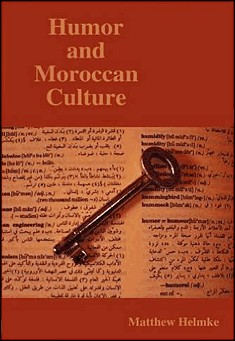
Humor and Moroccan Culture
by
Free ebook download: Humor and Moroccan Culture by , legally licensed and available in PDF format.
In this book, Matthew Helmke explores the hidden aspects of Moroccan culture. These are the things that Moroccans know inherently, without being taught. Culture book.
This project started as a language learning experiment. Matthew Helmke was sitting in a cafe with a Moroccan having a discussion in Moroccan Arabic. The friend told a joke and it was quickly discovered that vocabulary alone would not insure an understanding of humor. This prompted a question, "What did I miss?" In this book, Matthew Helmke explores the hidden aspects of Moroccan culture. These are the things that Moroccans know inherently, without being taught. The result is an intriguing look through the eyes of an American trying to make sense of Moroccan culture.
Excerpt:
This book will explore and discuss the hidden aspects of Moroccan culture, things that people who grow up in Morocco seem to know inherently. I started on this journey because of a joke. I was living in Casablanca at the time and had been studying Arabic1. My friend Mohamed told me a story and started laughing. He reached his hand out to shake mine in a gesture that has now become quite familiar—I like to call it the “we both enjoyed that joke” handshake of congratulation and friendship. As with most handshakes, it is followed by putting your hand on your heart. Unlike other handshakes, it is usually followed by all the parties discussing the joke you just heard and why it was funny. This is to make certain everyone understood it and can be included in the fun. I found the experience enjoyable, even though I had no clue what the joke was about. I was missing something and I didn't know what it was.
I decided to do two things. First, I asked Mohamed to explain the joke to me, line by line. After I learned all the vocabulary and figured out what all the sentences meant, I still didn't think the joke was funny. Mohamed explained it to me, but I didn't understand his explanation. I continued by asking him to explain how things would have normally occurred in that situation and suddenly something clicked. Here was an aspect of Moroccan culture that I had been missing completely. Immediately the joke made sense and I appreciated the humor of it.
The second thing I decided to do was birthed out of hat moment. I decided to ask people, everywhere I could, to tell me jokes. Then I would struggle through each one, trying to understand it, trying to figure out what made each joke funny in its original context. This has led me on a fun, and often difficult and overwhelming, journey of cultural and linguistic study.
Once I had acquired a repertoire of 30 or 40 jokes in Moroccan darija an expatriate friend asked me if I would consider writing them down for him to study. I hadn't thought of that earlier. Most of this still-growing collection was made for my personal benefit and stemming from my personality—I tell jokes all the time in my native language and I love to use them to help make new friends wherever I go. Jokes lighten the atmosphere and mood and help lower defenses. This makes train rides, café visits, and queues to pay the phone bill much more enjoyable.
I wasn't sure how a collection of jokes in Moroccan darija by a foreigner would be received and was pretty skeptical of the idea, so I shelved it for several years. Occasionally, one of my friends among the expatriate community in Morocco would ask me to tell them one of the jokes they heard me laughing over with our mutual Moroccan friends. I would oblige and translate the joke into English for them. Invariably, the non-Moroccan would not laugh. They wouldn't laugh even when I told it in Moroccan Arabic and they knew every word. From those moments I had an epiphany—you have to understand the cultural tidbit behind any joke for it to be funny. That brings us to the book you hold in your hands.