An Atheists’ Bible
by
Free ebook download: An Atheists’ Bible by , legally licensed and available in PDF, and ePub formats.
The type was sloppily composed, only a small quantity of copies printed – perhaps because in those heady days of the Dawn of the New Age, men’s eyes were on the Future ...
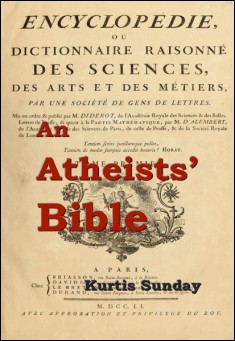
Paris, during the bloodiest days of the Revolution: a book entitled An Atheists’ Bible is discovered by the authorities. Though it is considered ‘profoundly reactionary and perversely pornographic’, it is published as an example of how decadent and corrupt life under the Old Regime had been. But what is An Atheists’ Bible and who wrote it? It is set in 1759 when the government of Louis XV was in the process of banning Diderot’s great Encyclopédie and the Seven Years War was raging. It purports to be a true account of how the printer Bageuret discovers a secret cache of twenty sets of the Encyclopédie in a Parisian warehouse and teams up with the aristocratic twins, Gilles and Sophie-Françoise d’Argenson, to sell them. But finding buyers and smuggling the books out of Paris proves more difficult than anticipated. The Encyclopédie has many enemies, including the Jesuit General and the fanatic Brass Head de la Haye, who are determined to see the death of the abomination. And Paris is a city of spies and informers, a heaving metropolis where the notorious cabinet noir tries to keep tabs on everything that happens in the so-called philosophy trade, the black market in illegal books.
Excerpt:
It took Sebastien Bageuret the best part of an hour to walk from the bookshop on the Rue Paradis to the Quai des Potiers. Being a Sunday afternoon, the Parisian waterside was deserted. A few barges lay idly at their moorings and a half-dozen tethered carthorses were grazing on a heap of hay. He was a small, spindly, middle-aged, sharp-featured man, and bald, but his impish skull was hidden by a wig that had seen several years of service and smelled more than faintly of printer’s ink.
His employer, Christine Charpentier, was waiting for him in a hired carriage. As she paid the coachman and instructed him to return an hour later, Bageuret attempted unsuccessfully to assess her mood. The widow, who by rights should have been in widow’s weeds, was dressed in a fawn dress and a brown cloak; a black diamond-shaped patch on the cloak’s lapel was the only indication of her state of mourning. Thick round spectacles made her eyes appear bigger than they actually were and gave her a somewhat owlish look. She had inherited the bookshop, and Bageuret with it, on the death of Jacques Charpentier. Bageuret had spoken to her only twice before, once when he had offered her his condolences at the funeral, and then later again when they’d met with Dreyfus, the lawyer, to make arrangements regarding the banking of the monthly take. He’d got the impression she knew next to nothing about the book trade and, for some reason he could not quite put his finger on, that she was pious to boot. But since then, she had simply let him get on with things. Which was just as well, the book trade was not a trade for Holy Marys.
“How can I be of service, madame?” he asked, when they were finally alone, hoping his politeness would not be mistaken for servility.
“It’s better I show you,” she said, indicating one of the warehouses.
The building was about three storeys high and, like most of the buildings along this stretch of the waterfront, had been built in the late 1600s. Bageuret suppressed a mild feeling of unease on seeing that it was the number 13.
She slammed the wrought-iron knocker on the door in the wooden-gated, Roman-arched entrance several times. The clang reverberated across the river. The gardien, a fat man who smelled of garlic and looked as if they had woken him up, appeared at the door. She showed him a pair of keys. He looked at them cursorily – both were stamped with the letters QdP and the number 13 – and let them in.
Inside there was a roofed courtyard, stacked high with sacks of corn and sugar. And beyond that, an arched passageway led into a second roofed courtyard, just as large, and also crammed with goods: bales of cloth on one side and, on the other, dozens of those distinctive wooden boxes from the royal porcelain works at Sèvres. The smell of spices, packing straw and something sweet and earthy, perhaps tobacco, permeated the dusty air. Bageuret followed her to a side door that led to some wooden stairs. Halfway up these, they came to a landing and another two flights of stairs, and then another landing, until they arrived at a double-locked door. She opened it with the keys.
The attic room contained four wooden crates.
“The lid of that one under the window is not fastened,” she said.
The crate was packed with books, large books, which did not surprise him that much; he’d guessed that Jacques Charpentier had his hiding places. Every bookmaker did. But he was surprised by what they were: more than a dozen of what looked like complete seven-volume sets of Diderot’s and d’Alembert’s Encyclopédie – in mint condition. Or rather, incomplete sets – a dozen or so further volumes were planned, or rather had been planned – it was becoming increasingly doubtful if they would ever be printed.
“There are twenty sets,” she said.
He picked up one of the volumes and felt its weight. He had to use both hands to hold it properly. His printer’s eye took in the dimensions: sixteen inches long, eleven inches wide and about two and a half inches thick. It was bound in quarter-of-an-inch thick card covered in light tobacco-brown leather. A red vertical block along the spine bore the words Dictionnaire des sciences; and underneath that, in a smaller green block, the lettering set horizontally, was the number of the volume and the letters indicating the articles within. The volume he had picked up was the first, the one with the articles on the subjects starting with the letter A. He opened it and for a moment savoured the smell of virginal paper and leather, the smell of a new book. The craftsmanship was superb. There had been no shoddiness in the making of these. The inside covers and the endpapers were marbled: a whirling pattern of bright red, green, yellow and blue ink. He turned to the title page, almost to convince himself he was actually holding the real thing in his hands: