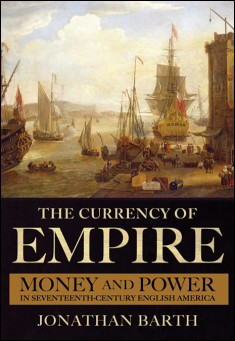
The Currency of Empire
by
Free ebook download: The Currency of Empire by , legally licensed and available in PDF format.
Explores the intersection of money and power in the early years of North American history, and he shows how the control of money informed English imperial action overseas.
The author explores the intersection of money and power in the early years of North American history, and he shows how the control of money informed English imperial action overseas.
The export-oriented mercantile economy promoted by the English Crown, Barth argues, directed the plan for colonization, the regulation of colonial commerce, and the politics of empire. The imperial project required an orderly flow of gold and silver, and thus England's colonial regime required stringent monetary regulation. As Barth shows, money was also a flash point for resistance; many colonists acutely resented their subordinate economic station, desiring for their local economies a robust, secure, and uniform money supply. This placed them immediately at odds with the mercantilist laws of the empire and precipitated an imperial crisis in the 1670s, a full century before the Declaration of Independence.
The Currency of Empire examines what were a series of explosive political conflicts in the seventeenth century and demonstrates how the struggle over monetary policy prefigured the patriot reaction to the Stamp Act and so-called Intolerable Acts on the eve of American independence.
Excerpt:
Silver, Mercantilism, and the Impulse for Colonization
Silver and gold coin and bullion permeated world markets as never before in the sixteenth and seventeenth centuries. The inexorable current of metals, especially of silver, from the Americas and Japan permanently transfigured some of the most important political, economic, and social institutions in Europe and across much of the globe. Affluent merchants and companies in select cities in western Europe controlled much of the global silver trade; in silver, they finally possessed a good as highly in demand in China and India as Eastern goods were in Europe. The economic advantages accruing to these merchants and companies, and the political advantages accruing to the countries to which they belonged, were extraordinary. Silver and gold not only provided merchants and consumers with the means to buy an unprecedented abundance of merchandise abroad, but also financed the steady accretion of state power and military might in the several Atlantic-bordering countries in Europe—all resulting in the formation of a highly competitive, multinational, European managed, global empire of silver.
The underlying significance of silver and gold to the state and economy— to power and to plenty—provoked a calculated scramble between rival European empires for the two coveted metals. By the early decades of the seventeenth century, in England especially, a new way of thinking about the state and economy—an order retrospectively labeled mercantilism—came to dominate most ideas and conversations about the general benefits but also potential pitfalls of foreign trade. This development carried vast political implications. Mercantilism emphasized the role of the state in managing trade so that silver and gold accumulated and remained within national borders. For this ac- cumulation of metals, a favorable balance of trade was most necessary. Exports, on balance, must exceed imports. Only through an overall trade surplus would silver and gold enter into and, on balance, remain within a country. Mercantilists no doubt were a heterogeneous bunch, particularly in England, deviating broadly on specific strategy and policy prescriptions. All agreed, however, on the balance-of-trade doctrine, and all agreed that while the incoming cur- rent of silver and gold was not the end in itself, it was in fact the optimum way to enhance national power, prestige, security, and plenty. Money was the means to secure the empire’s chief ends.
Mercantilism, as such, became as good as sacrosanct in most economic and political thought in seventeenth-century England. An often tense alliance of merchants and government—of capital and coercion—propagated, debated, and furthered the predominant principles and divergent methods of mercantilism, resulting in the growth of an English empire that functionally benefited both groups, broadly considered. Colonial plantations, in particular, ranked among the most emphasized and prized of all mercantilist assets.
On the eve of the sixteenth century, the world’s most lucrative trade routes passed through the Middle East into Asia. Porcelain, silk, cotton, and spices traversed hundreds and thousands of miles, with gold and silver mediating, as money, a great bulk of this exchange. Most gold derived from West Africa, with smaller sums produced in Nubia, Ethiopia, Zimbabwe, the Balkans, the Caucasus, and Southeast Asia; the bulk of silver derived from central Europe, with smaller quantities arriving from Persia and China. China and the Indian subcontinent each boasted populations exceeding one hundred million; China comprised the world’s largest economy even after the recent turn of the Ming dynasty inward from maritime trade and overseas exploration. The Ottoman Empire governed a smaller, more diffuse population of twenty million; Otto- man rule, nonetheless, brought much-needed stability and order to overland trade routes, its merchants profiting signally as middlemen between Asia and Europe, even before the empire’s conquest of Constantinople in 1453.
Europe was on the periphery of this semiglobal trade network. Approximately seventy million inhabited the continent, but with a much lower population density than either China or India and with greater political fragmentation than any other core region. During the High Middle Ages, however, and accelerating through the fifteenth century, Europe’s political and economic condition had rapidly altered. Its princes fielded larger armies and mobile artillery, rendering castles and fortifications less secure while encouraging more consolidated political units capable of extracting the money required to finance these new, more expensive methods of warfare. European rulers still extracted the bulk of their revenue from tribute, fees, and land rents, but an increasing number of states now also turned to merchants for loans, and some foresaw tremendous revenue potential in taxing commercial enterprise. European market activity had widened considerably in recent centuries; more and more capital accumulated in mercantile hands, centered in towns and cities where a budding class of urban and semiurban artisans and tradesmen signaled the onset of a more commercial future for Europe. Though the peasantry remained rural and mostly bound to the land, the older feudal world in which static, immobile land- holdings constituted the highest form of wealth was already giving way gradually to a commercial world demanding fluid capital and a vibrant merchant class for the distribution of international goods, setting the stage for silver and gold to supplant land as the most desired commodity in Europe.