Unruly Hearts
by
Free ebook download: Unruly Hearts by , legally licensed and available in PDF, and Word formats.
SYNOPSIS
One evening in March 1965, a young stranger arrives in the village of Castle Devereux, a few miles from Cuckoo Farm, to begin a new life with her Aunt Ada. She finds the villagers are troubled by a group of ghosts, child ghosts. They’ve apparently been around since the seventeenth century. And they are, she’s told, a particular danger to her. The villagers are mostly friendly. But not all of them.
Despite the opening chapter, this is not a novel for young readers.
She is a fearless girl and she takes on the challenge. Her favourite person is her next-door neighbour, an endearing and eccentric Brigadier, long-retired from the Army. She also gets on well with the owner of the ruined castle, Jack Touchard. They become friends and she learns about his history, in particular his childhood during the London blitz.
Her most important relationship is going to be with her Aunt. But it gets off to a bad start.
Excerpt 1 ~
The orphanage in Birmingham had a motto – Speak up. Speak out. And speak true. The matron was very serious about that, constantly reminding the children of its importance. ‘If you find yourself in difficult circumstances,’ she said, ‘you know what you must do: Speak up. Speak out. And speak true! Always!’
So when Irony learned that she was going away to live with her aunt, she prepared a speech. She re-read the words and memorised them. Then she practised them on her friends, seven girls crowded round her bed in their pyjamas, and three boys who had no business to be there – and ran away squealing when the night staff came round for lights-out.
She went through the speech in her head three times on the train from Birmingham to London.
After supper, Auntie Ada leads her upstairs and into a large bedroom. Space for five or six people in here, Irony thinks. But it’s a nice room, with a sloping ceiling at one end, a soft rug on the floor, and dark old-fashioned furniture. A small vase of spring flowers stands on a mahogany table at her bedside.
‘You can get up whenever you like tomorrow,’ her aunt says. ‘I avoid rules as much as possible.’
As her aunt turns to leave, Irony says: ‘There’s something I want to say.’
Auntie Ada turns round and stands in the doorway of the bedroom, stooping because she’s tall and the top of the doorway is low. Irony faces her, standing by the foot of the bed. Then, speaking in a formal way because this is important to get right, she says the words she had memorised.
‘Thank you for inviting me here. I will do my best to be well-behaved and contented, but I want you to know that I was very happy at the orphanage and I didn’t want to leave.’
‘Oh!’ says Auntie Ada. Irony can see she is flummoxed. ‘I see,’ she says. ‘Well, goodnight dear.’
Speak up. Speak out. And speak true!
Next morning, Auntie Ada looks as if she’s had a sleepless night. When they’ve finished their breakfast, she sits up straight and prepares to speak. Irony senses that she’s going to say something important.
‘I’ve thought a lot about what you said last night,’ she says. ‘And I’ve come to the conclusion that I acted very foolishly. I should have visited you and got to know you before I invited you here. And most important of all, I should have asked you what you wanted to do. I was selfish and thoughtless.’
She pauses at that point and Irony waits.
Her aunt bursts out desperately: ‘It never occurred to me that any child would want to stay in an orphanage if a proper home was offered!’
Still Irony says nothing.
‘But the damage is done now, and I apologise. But it still has to be dealt with – and I think the best way of doing that would be a bargain between us. So I suggest you agree to stay here for a month, for a trial period. And at the end of that time you can choose whether to stay here or not. If you want to go back to the orphanage, I promise not to stop you. In fact, I’ll take you there myself. That’s a way of being fair to both of us, I think.’
Irony is unsure what to say.
‘A trial run,’ her aunt says. ‘What do you think?’
‘In a month’s time,’ Irony says slowly, ‘there won’t be a place for me at the orphanage. They will have found someone else.’
And when Auntie Ada fails to reply, Irony continues. ‘In fact, they’ve already found someone. My place has already been taken. They told me before I left.’
Auntie Ada’s dismay can be seen in her face. She’d put a lot of faith in this bargain she’d thought of.
‘Her name is Kirsty. They told me. She was expected to arrive yesterday, soon after I went. She needed somewhere – she’s been living on the streets, with her mother. But she’s in prison now – I mean her mother is in prison.’
Irony has so far tried not to think about Kirsty, who has already spent a night in her bed, chatted to her friends in the dorm, and probably sat for meals in her favourite place in the dining-room.
‘Well,’ her aunt says. Her tone is sharp. ‘What a pity I didn’t know about Kirsty! I could have invited her to come and live with me. She would have had a proper home to live in, I would have someone to keep me company, and you could have stayed in your beloved orphanage!’
There is nothing Irony can say in reply to that.
‘So you’ve burnt your boats,’ her aunt says.
‘No,’ Irony says sadly. ‘You burnt my boats.’
*
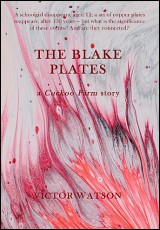
Readers of the previous two novels in this series will remember the private investigator, Cressida Benbow. Her outward day-to-day life in 1965 is apparently orderly and unremarkable, certainly not troubled by ghosts. Patrick, her lover, is in West Germany, still serving in the Army, and it is assumed they will marry eventually. In The Blake Plates, she’d found herself involved in a case of child trafficking and sex abuse. Now she’s drawn back ever further into confronting this issue. When she accepts a challenge to solve an especially puzzling mystery, it leads her ¬– reluctantly – into an ugly case of violence, death, and child abuse. At its heart is someone she has met before, Myluv, the mountain-man.
There’s someone else. When readers last encountered Zoe Whittaker, she’d been preoccupied by mermaids. She is seventeen now, still living at Cuckoo Farm with her aunt. But her challenge is different, and no ghosts are involved. She’s a young woman, a strong authoritative figure, at the top of her school, preparing for her A Levels. She decides one day to write her memoir. In doing so, she re-discovers an old forgotten memory: when she was eleven she had befriended her English teacher. Now, aged seventeen, she finds herself enclosed in a private world of loving and joyous young-adult sex, with all the anxieties and tensions of the 1960s.
Throughout history, passionate sex between young people has usually been regarded as socially disruptive, in need of control and containment. Unruly Hearts tells the story of how well Zoe Whittaker and Tom Boon do – or don’t – find safe ways through the uncertain difficulties facing them, even in the great awakening of the 1960s. They are not troubled by ghosts, but there are hints of the magical, or more strictly the early medieval, lurking inside or behind their narrative.
It’s a very old story.
VW
2025