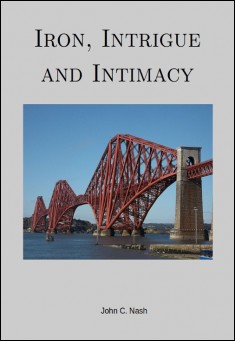
Iron, Intrigue and Intimacy
by John C. Nash
Free ebook download: Iron, Intrigue and Intimacy by John C. Nash , legally licensed and available in PDF, ePub, and Kindle formats.
The beginning of a year in which the world of iron, steel and steam would collide with that of a criminal plot, overlaid with a delightful new dimension of partnership ...
When my wife Amelia and I travelled to Edinburgh on October 31, 1895, it was so I could participate in an engineering meeting of my railway clients. Little did I realize that this trip would be the start of a year in which the world of iron, steel and steam would collide with that of a criminal plot, overlaid with a delightful new dimension of partnership, collaboration and sharing with Amelia.
Excerpt from this popular historical fiction book:
Sir Joseph Pease, Chair of the North Eastern Railway, called us to order at 2 o’clock on November 1, 1895. We were meeting in a hotel in Edinburgh in a room that usually would serve for private dinners.
I had been invited – though it was essentially a command – to attend this special meeting of various men who served the NER and its Great Northern Railway partner. We were to discuss what, if anything, should be done in reaction to the October 22 disaster at Montparnasse Station in Paris. Unfortunately, a train that was possibly going too fast and whose Westinghouse brakes had failed did not stop at the end of the line, instead traversing the concourse and leaving the front of the station to end with the locomotive front bogies on the pavement below. There were injuries and fatalities. The GNR and NER were concerned that either there were faults in the Westinghouse brakes which could affect their trains, or that there might be malicious activities afoot.
My own role was as a consulting engineer, but I gained a premium on my fees for working exclusively for the GNR and NER in the railway sphere of my work, which was largely related to calculations pertinent to mechanical objects – bridges, boilers, cables, girders, and so on. My modest company – myself and a couple of others – did well by being good at getting the numbers correct and quickly. Whether I was well-suited to the current meeting, I did not know.
There were about 20 of us in the room. I was acquainted with most of them, having crossed paths over a couple of decades of work related to different engineering projects. They were mostly good engineers, though a couple were, I feared, likely to err towards profit rather than safety if serving one meant the other could not be realized.
Before the meeting started, Pease had come over to greet me. As we shook hands, he whispered “Stay behind after the meeting. I’ve an important matter to discuss with you, and you alone.”
During the meeting, which consisted mostly of aimless speculation concerning either malicious agents or failures of American engineers, my thoughts were mostly occupied with what Pease wanted to talk to me about. At about 4 o’clock, there was a hiatus in the discussion when the clink of teacups was heard in an adjacent room. Pease said “Gentlemen, I think we might stop here. Mr. Rushbrooke has, I believe, taken notes and will write a précis of our deliberations. I thank you all for your participation. Please submit your expenses, and as appropriate your invoice for fees, to Mr. Rushbrooke and you will be compensated accordingly. There are refreshments in the adjacent room.”
The NER was well-known for outstanding refreshments, and the men in the room exited with almost indecent haste. I trailed the mob and closed the door behind the last of them.
“What did you wish to talk to me about, Sir Joseph?”
“Well, Carr, you’ll have noticed that our esteemed colleagues managed to use a great many words to say what I’m sure they know we have already considered. However, Rushbrooke’s report will serve to give us a measure of protection, or at least evidence that we tried to anticipate negative events, should something untoward happen.
However, I and my corresponding number at the GNR, Mr. Jackson, feel we would like to know what the true dangers are, and whether they are due to saboteurs, engineering failures, or human stupidity. We think you have the range of knowledge and good sense to investigate this for us. If you are willing, we will pay you for six months of your time plus all expenses, and we will instruct our employees to give you full cooperation. We would like a report on what you feel are the real matters that could cause our passengers and staff to be hurt or killed. Secondarily, we would ask you to note avoidable risks to our profitability, but only AFTER you have considered safety.”
“I will have to make sure our firm can give you the time you request, Sir Joseph, but I applaud your objective, and can say I think it a worthy one.”
“When can you give us an answer on your availability?”
“We plan to be home in Tunbridge Wells by Sunday night, so I’ll be able to talk to my colleagues Monday. I was talking with McNaughton, one of the men here, about the Forth Bridge, and he has offered to give me a tour tomorrow. That actually could be a useful introduction to your project. In any event, you should have my answer Wednesday. Should I have obligations that prevent me giving you my full attention for six months, do you wish me to suggest alternative possibilities?”
“That would be disappointing, but it would likely be sensible to consider reasonable amendments to our schedule. I should add that there have been one or two hints that there are people who may be thinking of active damage to our equipment or track, and that we would expect you to be cautious. Your introduction to our staff or suppliers will not mention that, of course, and it should be kept confidential unless there are imminent dangers.”
“Would it be appropriate for my wife Amelia to accompany me for some of the investigations? She generally edits and sometimes transcribes my reports, and is acquainted with my work, often suggesting improvements. It could save considerable time and busy work if we avoid the transcription of my notes. Moreover, we can commence editing them more quickly, and you may be assured that she is fully cognizant of the need for discretion and confidentiality in work such as this.”
“You are fortunate, Mr. Carr. Yes, that would be acceptable, and we would cover your joint expenses, though the fee would be as proposed.”
“Thank you, Sir Joseph,” I replied, thinking that Amelia was probably worth more on such a project as this than most of the men who had been in the room earlier.
* * * * * * * * * * * * * * * * * * * * *
I limited my indulgence of the refreshments to a cup of tea and a couple of delightful shortbreads. As it was then approaching five o’clock, I ascended to our hotel room. The railways had chosen a small but decent hotel that was not, to my knowledge, generally used for meetings. They were worried that publicity about the meeting might give credence to the possibility of deliberate damage in relation to the Montparnasse crash. Or were they fearful that it would affect revenues and profits?
Amelia was lying on the bed when I came in the room. She had removed her skirt, jacket and blouse, as well as her corset.
“Richard. Has your meeting ended?”
“Yes. All done for today, and actually for this trip. But Pease wants me to do a six-month study of potential dangers to the GNR and NER. There’ll also be expenses, and they will include provision for you to accompany me. I just wish I could bill for your time, since you make sure our reports are well-presented and clear of silly errors.”
“I’m surprised they would countenance including me in the expenses, but am grateful. I find myself becoming more and more sympathetic to the Women’s Franchise League.”
“We need to talk to Parks, Crane and Komarova.” The first two were apprentices we took on over the years who have stayed with us. Komarova is an exiled Russian woman who does calculations for us on a piece-work basis. She makes much more money than she would from a wage, since she is very good at computing, and she can choose her time of working to suit her family’s needs.
“From my recollection of our current work, it should be possible for us to take on the assignment,” Amelia said. “But you should also include Gus. He’s 21 now.”
Gus – Augustus – Carr was a nephew we’d taken on in 1888 as an apprentice. He’d done well. That I had overlooked him was because I still thought of him as a boy, which was, to my embarrassment, no longer the case. Indeed, he had finished his apprenticeship, though the transition to junior engineer was unnoticed – he had been doing real work for several years.
“Yes. He should be included too. That is my mistake, based on still thinking of him as a youth.
To continue, Sir Joseph cautioned that there had been some information that there are people actively trying to damage railway equipment or operations, but we are to keep that aspect of the investigation under our hats.”
“Do you think there may be personal danger?” Amelia asked, but not with any particular concern in her voice.
“I would suspect that if we stumble upon plans for some sort of malevolent operation, those involved might be expected to try to thwart efforts to stop them. You may recall that a railway policeman – Robert Kidd was his name – was killed at the end of September at Wigan railway station. The accused in that crime are before the courts now. So in that respect, there would be personal danger.
While there are a number of groups interested in causing trouble for Great Britain, and I would expect the railways are symbolic of British progress and wealth, my current estimation is that human error and failures of equipment or materials are more probable risks. Still, the Irish are still unhappy, and there was that strange French anarchist who blew himself up at Greenwich Observatory in February 1894, as well as the assassination of French President Sadi Carnot, whose uncle was the celebrated engineer who did so much to explain thermodynamics. There’s also the Montparnasse crash that isn’t properly explained.”
“But you’d like to do the investigation?” Amelia asked.
“I think it’s important that someone – someone competent of course – do it.”
“And you, Richard, are very competent at what you do.” She gave me a kiss.