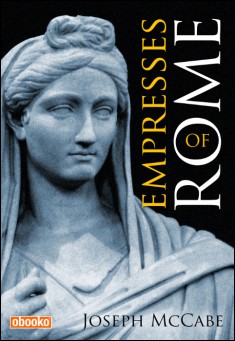
The Empresses of Rome
by
Free ebook download: The Empresses of Rome by , legally licensed and available in PDF, and ePub formats.
Immerse yourself in the rich tapestry of Roman society as you unravel the hidden stories of these remarkable women, who conquered hearts and empires alike. Free eBook.
Introducing The Empresses of Rome: Revealing Tales of Powerful Women in Roman History.
Step into the ancient world of Rome with our captivating free book, The Empresses of Rome. Delve deep into the lives of bold and influential women who stood beside their husbands, wrote their own narratives, and left an indelible mark on the history of the Roman Empire.
Immerse yourself in the rich tapestry of Roman society as you unravel the hidden stories of these remarkable women, who conquered hearts and empires alike. Travel back in time and witness the triumphs, tribulations, and audacious strategies employed by these empresses to shape Rome's destiny.
Through meticulous research and engaging storytelling, Joseph McCabe has captured the essence of these extraordinary women, shedding light on their complex personas and giving a voice to the often-forgotten heroines of ancient Rome. Imbibe the knowledge of their struggles and victories, as you gain a deeper understanding of the intricate web of Roman politics, culture, and power dynamics.
Whether you are an avid history enthusiast or simply seek a riveting read, "The Empresses of Rome" is the ultimate companion to satiate your curiosity. Unlock the secrets of the Roman Empire's hidden gems within these pages and get ready to embark on a thrilling journey back in time.
As you flip through the narratives and gaze at the collected images of busts and statues, let the Empresses transport you to an epoch of grandeur and allure. Unearth the untold stories of captivating women who defied conventions and forged their places in history, leaving an indelible mark on the annals of Rome's glorious past.
Excerpt:
On an August morning of the year 29 B.C. the million citizens of Rome lined the route which was taken by triumphal processions, to greet the man who brought them the unfamiliar blessing of peace. From the Triumphal Gate to the Capitol, past the Great Circus and through the dense quarter of the Velabrum, with its narrow streets and high tenements, the chattering crowd was drawn out in two restless lines, on either side of the road, ready to fling back the resonant “Io Triumphe” of the bronzed soldiers, bubbling with discussion of the war-blackened stretch of the past and the more pleasant prospect of the future. The hedges of spectators were thicker, and the debate was livelier, under the cliff of the Palatine Hill and in the Forum, through which ran the Sacred Way to the white Temple of Jupiter, towering above them and crowning the Capitol at the end of the Forum. There the conqueror would offer sacrifice, before he sank back into the common rank of citizens of the Republic. Would the young Octavian really lay down his power, and become a citizen among many, now that he was master of the Roman world?
Possibly one woman, who looked out on the seething Forum and the glistening temple of Jupiter from a modest mansion on the Palatine Hill, knew the answer to the eager question. Possibly it was unknown to Octavian himself, her husband. She heard the blasts of the leading trumpeters, and saw the sleek white oxen, with their gilded horns and their green garlands, advance along the Sacred Way and mount the Capitol. She saw the people rock and quiver with excitement as painted scenes of the remote Dalmatian forests, where her husband’s latest victories had been won, and the gold and silver of despoiled Egypt, and the very children of the witch Cleopatra, were driven before the conqueror. She saw the red-robed lictors slowly pass, their fasces wreathed in laurel; she saw the band of dancers and musicians tossing joyful music in his path; and she saw at last the four white horses drawing a triumphal chariot, in which her husband and her two children received the frenzied ovation of the people.
Octavian was then in his thirty-fourth year. Fifteen years of struggle had drawn a manly gravity over the handsome boyish face, though the curly golden hair still seemed a strange bed for the chaplet of laurel that crowned it. His full impassive lips, steady watchful eyes, and broad smooth forehead gave a singular impression of detachment—as if he were a disinterested spectator of the day’s events and the whole national drama, instead of being the central figure. The busts which portray him about this period seem to me, in profile, to recall David’s Napoleon, without the slumbering fire and the hard egoism. Men would remind each other how, when he was a mere boy, fifteen years before, he had found his way through a maze of intrigue with remarkable dexterity. Now, Mark Antony was dead, Brutus and Cassius were dead, Lepidus was dead, and the followers of Pompey were scattered. It was natural to assume that dreams of further power were hidden behind that mask of strong repose.
Behind Octavian went the body of Senators, with purple-striped togas, and silver crescents on their sandals. The lines of spectators broke into gossiping groups when the tail of the procession had passed on. The white oxen fell before the altar of Jupiter. Octavian gave the customary address to the Senate, and joined Livia in the small mansion on the Palatine. But for many a day afterward Rome bubbled in praise of him. Not for years had such combats reddened the sands of the amphitheatre, such clowns and conjurors and actors filled the stage of the theatre, such sports fired the 300,000 citizens at the circus. Never before had the uncouth form of the rhinoceros or hippopotamus been seen at Rome. Not since the beginning of the civil wars had so much money flowed through the shops of the Velabrum and the taverns of the Subura. Such wealth had been added to the public store by the despoiling of Egypt that the bankers had to reduce the rate of interest. To a people grown parasitic the temptation to make a king was overpowering; and it was easy to point out, to those who clung to the strict democratic forms, that Octavian was extraordinarily modest for a man who had reached so brilliant and resourceful a position. So, within a few months Octavian was Imperator, and Livia became, in modern phrase, the Empress of Rome.