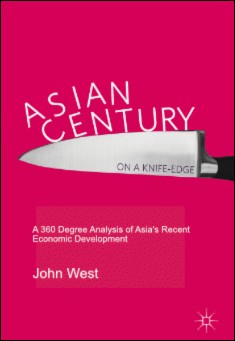
Asian Century… on a Knife-edge
by
Free ebook download: Asian Century… on a Knife-edge by , legally licensed and available in PDF, and ePub formats.
This book delves into the widely held belief that the 21st century will be the Asian Century by examining the Asia's rapid economic development in the post-war era and the challenges it faces in forging ahead of world leaders in the West.
This book delves into the widely held belief that the 21st century will be the "Asian Century" by examining the Asia's rapid economic development in the post-war era and the challenges it faces in forging ahead of world leaders in the West.
- Re-evaluates the conventional wisdom that the 21st century belongs to Asia
- Dissects Asia’s economic, social, political and geopolitical challenges
- Provides a timely preliminary assessment of the impact of the Trump presidency on Asia
The impact of the current turbulent global political climate on Asia is critically analyzed, employing a holistic and multidisciplinary approach, combining economic, social, political and geopolitical perspectives. Written in an accessible style, the book offers students, business, government, and civil society players powerful insights on Asia.
The author, John West, has had a long career in international economics and relations, with major stints at the Australian Treasury as director of balance of payments, OECD as head of public affairs and director OECD Forum, and Asian Development Bank Institute as senior consultant for capacity building and training. He also taught globalization at the Institut d'Etudes Politiques (Sciences Po) in Paris. John is now adjunct professor at Tokyo's Sophia University, contributing editor at FDI-Intelligence, a Financial Times magazine, and executive director of the Asian Century Institute.
Excerpt:
“Yes, China is slowing down, but compared to the West, its GDP growth is enviable,” once said Jon Copestake of the Economist Intelligence Unit .1 This is a familiar refrain in media reports, international conferences and business discussions.
But all economies which are behind world leaders (like the US and Germany) have great potential for rapid, catch up growth. And the further they are behind, the faster they can grow, just by absorbing knowledge and technology from world leaders. This is the “benefit of backwardness”.
It is thus not surprising that China should still be growing so quickly. Its GDP per capita is still only one-quarter of that of the US. It would be much more surprising if China were not growing so quickly. The real disappointment is that so many other countries cannot get their act together to achieve fast, catch up growth.
The main question facing China today is whether it can stay the course in catching up to world leaders, because other Asian economies like Japan , Korea and Taiwan have not managed to do so.
Indeed, the post-war waves of high-growth Asian economies, beginning with Japan, have been arrested. Asia’s major economies now face the prospect of permanently stunted development. There is now very little prospect of full catch up to the world’s leading economies in terms of GDP per capita, and economic, business and technological sophistication.
Japan’s very rapid recovery from the ashes of World War 2 took the world by surprise. Many economists were then pessimistic about the prospects for Asia, which suffered greatly from the War. The continent had few natural resources and an enormous population compared with Africa and South America. But as Japan’s growth continued, many then believed that Japan would overtake the US, in much the same way that the US overtook the UK in the nineteenth century.
Japan’s economic dynamism inspired the four Asian Newly Industrializing Economies—Hong Kong , Korea, Singapore and Taiwan —on a similar path of rapid development. This gave rise to talk of an “Asian miracle” by the World Bank 2 and others, and the group was labeled the Asian tigers.
Much ink has been spilt in analyzing the rise of these Asian economies. The main factors were their export-orientation, good education , macroeconomic stability and strong government leadership. But as Ian Buchanan has argued,3 geopolitics also played an important role in the context of the Cold War, as the US offered official assistance and open markets to its friends in Asia. And all of these successful economies were motivated to become strong in the face of their threatening neighborhoods, as they faced Mao’s China, North Korea and the USSR.
But the shortcomings of the Japanese model became all-too-apparent following a financial crisis in the early 1990s. Japan (and Korea and Taiwan ) has since failed to both reform its economy and deal with demographic decline. The prospect of these economies catching up to world leaders now seems remote.
Singapore and Hong Kong are rare birds in Asia, in that they have caught up to the US and Germany, and in Singapore’s case well overtaken them. There are some very simple reasons. Both are Asia’s only two genuine open market economies, with large immigrant populations, in contrast to Japan, Korea and Taiwan . They are also financial centers and tax havens, which allow Asia’s super rich to hide their (often ill-gotten) wealth from the taxman. When these city economies are compared with other financial centers like London, New York or Switzerland’s Zurich, their success seems much less surprising.
The next group of Asian economies to take off in the region’s “flying geese” pattern4 of development included Malaysia , Thailand and Indonesia . Their rapid development was mainly driven by a wave of investment from Asia’s advanced countries, which offshored lower-value-added activities as they climbed the development ladder. But the education and technological capacities of these countries are relatively weak, and their economic catch up to date remains modest. These countries would seem to be caught in a “middle-income trap ”, meaning that they are unlikely to graduate from middle-income to high-income status.
China stunned the world with three decades of 10% growth rates, following its opening up, which began in 1978 (more recently, Vietnam launched a similar opening to the world economy). Today, the future of the Chinese economy is problematic, as the government seems almost paralyzed by the social and political risks of undertaking reform. China may well have the world’s biggest economy, but it remains a relatively poor country, with an enormous population. It also faces a grave risk of getting stuck in a middle-income trap .
India is the other Asian giant, with an enormous population. It began its reform in the early 1990s and has since achieved good economic growth. While there is a lot of positive momentum in the Indian system, it also faces immense challenges.