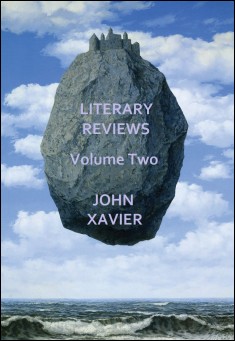
Literary Reviews Volume 2
by
Free ebook download: Literary Reviews Volume 2 by , legally licensed and available in PDF format.
A series of essays that mostly deals with works of literary fiction. A few odd books get reviewed too; a MLM book for one. Most notable is a review of the Kaneko Tota omnibus.
76 pages. 26,000 words. A series of essays that mostly deals with works of literary fiction. A few odd books get reviewed too; a MLM book for one. Also, several of the essays are less than a thousand words but the two most notable ones are a review of the Kaneko Tota omnibus that runs to 1400 words and a review of Infinite Jest that almost hits 5900 words. The full list of books reviewed is as follows:
Introduction: On What Defines Great Literature
THE POWER OF VISION: Solmaz Sharif’s ‘Look’
DIDACTICS: Cormac McCarthy’s ‘Stella Maris’
NON-MAGICAL REALISM: César Aira’s ‘Conversations’
POETRY BARED: Ama Codjoe’s ‘Bluest Nude’
BLEEDING THE REAL: Ocean Vuong’s ‘Night Sky with Exit Wounds’
FACETS OF A DREAM: Italo Calvino’s ‘Invisible Cities’
SEQUEL PROBLEMS: Liu Cinxin’s ‘The Dark Forest’
WILD HEART: ‘Haiku as Life’ (A Kaneko Tōta Omnibus)
LABOR PAINS: Ocean Vuong’s ‘Time is a Mother’
LITERATURE AS APOCALYPSE: Northrop Frye’s ‘The Great Code’
NARRATIVE CHIAROSCURO: Cormac McCarthy’s ‘All the Pretty Horses’
A STRANGER’S BODY: Eliot Page’s ‘Pageboy’
MEDITATIONS ON DISCONNECTION: Solmaz Sharif’s ‘Customs’
ORCHESTRA OF SELF: Evelyn Lau’s ‘A Grain of Rice’
VOID IN THE MIRROR: Don DeLillo’s ‘The Silence’
NO IMPOSTURE HERE: Molière’s ‘Tartuffe’
NOT ON THE LEVEL: Sarah Robbin’s ‘Rock Your Network Marketing Business’
AN EXAMPLE LESS EXEMPLARY: Hemingway’s ‘To Have and Have Not’
FEAST OF IMAGINATION: Liu Cinxin’s ‘Death’s End’
FELLOW CREATURES: Andrew Lipstein’s The Vegan’
LITERARY CONVEXITY: David Foster Wallace’s ‘Infinite Jest’
DIVERSE ENCHANTMENTS: ‘The Arabian Nights’, Translated by Husain Haddawy
Excerpt:
FACETS OF A DREAM: Italo Calvino’s ‘Invisible Cities’
Sometimes it’ll be some random thing of curiosity that’ll pique our interest in a book. This was what happened with me here when I took Calvino’s slim volume off the shelf and noticed the headings in its table of contents. Cities & Memory, Cities & Desire, Trading Cities, Thin Cities, Cities & the Dead, etc: the unusual modulation and repetition I was immediately presented with was interesting enough that it swayed me to add Invisible Cities to the healthy stack of books I was already getting. And as it turned out, these chapter titles were much more telling than I innocently imagined; while also mirroring the book’s biggest flaw.
Yeah, this is a very repetitive work and one in which there’s basically no meaningful development. Loosely held together by a series of hallucinatory dialogues between Marco Polo and Kublai Khan, that seems to be little more than an ad hoc device to justify the bundling and brute cavalcade of roughly fifty or so familial prose poems. And at first these are presented to us as descriptions of separate cities but then the premise of that separateness undergoes a deconstruction in the dialogic interludes. In truth though, nothing’s really at stake here either way because the whole novel, if you’re willing to call it that, is so vaporous in style and content that the possibility of consequence is pre-emptively excluded.
As such there isn’t much of an impetus for the reader to press forward other than the quality of the poetic prose and imagery. These are reliably good, even excellent in places, so it’s a shame more wasn’t done on the narrative end. I mean, Kublai Khan and Marco Polo are intriguing historical figures and their dynamic comes with inherent dramatic possibility (The clash of cultures, the asymmetry in power, and so on) Calvino doesn’t seem to have been interested in any of that though. You could easily substitute another historical leader and their diplomat and I don’t think anything would’ve been gained or lost. The author in this case appears to have been preoccupied with abstract considerations, with a host of circuitous ideas bound up in a dreamlike urban spectatorship. So as a novel I ultimately found it unsatisfying but, judged as poetry, it does fair better. Taken in fragments, the writing is quite fine and displays all the finesse you’d expect of someone with Calvino’s reputation. It just loses most of its impact in the overall redundancy.