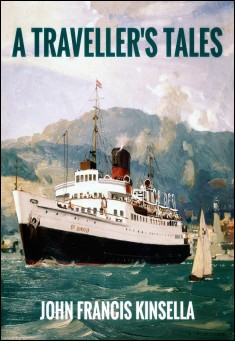
A Traveller's Tales
by
Free ebook download: A Traveller's Tales by , legally licensed and available in PDF format.
A look back at the times of an impecunious young Londoner starting out in life in the middle of the last century, and his discovery of the pleasures of travel.
A look back at the times of an impecunious young Londoner starting out in life in the middle of the last century, his discovery of the pleasures of travel, and how he learns to see the world on the firm’s expense account, in the days before internet, mobile phones, instant communication and low cost travel.
Excerpt:
As I write, there is not a corner of the world devoid of tourists of some kind, the vast majority of them ordinary people from all walks of life and every continent now able to afford a flight to what were once unimaginably distant lands, criss-crossing the globe in every direction, Westerners east to India and China, Asians to Europe and the Americas, Middle Easterners and Africans to the great capitals, and the more adventurous travellers seeking new experiences in the African savannas, Patagonia, New Guinea and even Antarctica.
How many of us have paused to admire a remarkable edifice or landscape, congratulating ourselves on our good fortune to have this unique privilege, when, suddenly a coach pulls up and discharges an unruly crowd of silver haired retirees wielding smartphones, wearing tee-shirts bearing the badges and slogans from the Burnley Welfare Association or the Aubervilliers Scrabble Club.
Of course that is condescending, but aren’t tourists defined as everyone but ourselves, we who are travellers.
Over the course of history, men from civilised nations had only two reasons to travel—trade and war. There was of course diplomacy in its different forms, including Papal envoys, they were cardinals, priests or other orders. But these were few compared to those who fought or traded beyond the borders of their own lands.
In the nineteenth centuries a new kind of traveller appeared in the form of what we would call tourists. They included scholars, writers, adventurers, young men and women, following in the footsteps of the privileged seventeenth and eighteenth century travellers. Their goal was to broaden their education, horizons, learn another language by spending two or more years on the continent on what became known as the Grand Tour.
It was the birth of tourism and reserved for the upper classes of British society in the days when travel was a costly time consuming affair.
That all changed with the advent of air travel and the modern jet airliner at the end of the 1950s, which in three or four decades opened the world to the common man and his family.
Until that time flying was for the rich and adventurers. My first flight was in Chipmunk at RAF Croydon when I was fifteen years old. Before the WWII, Croydon was London’s first international airport where Imperial Airways established its base and launched its first luxury passenger airliner service with the Handley Page HP42 in 1931. On the outbreak of war, Croydon Airport became a fully operational frontline fighter airfield, forming part of No.11 Group, Fighter Command, whose Hurricanes and Spitfires defended London against Hitler’s bombers.
After the war it was returned to civilian use and though Manchester University Air Squadron was based in one of the wartime hangars flying Tiger Moths and Chipmunks, providing elementary flight training for Royal Airforce volunteers and the Air Training Corp cadets of which I was one.
This social revolution came suddenly in the space of a little more than a decade, from the mid-fifties to the mid-sixties, with paid holidays and jet travel. Before that time, travel for the ordinary man came with military service, as merchant seamen, emigration, or not that far back transportation to a penal colony in the Antipodes. The better classes discovered the world as administrators in the colonies or as missionaries. Others were diplomats, officers, scholars, archaeologists, merchants, travellers and adventurers.
As late as the thirties individual travel to Turkey, Iran, Afghanistan and India merited sponsorship by a newspaper followed by a best selling book. The Swiss traveller, Ella Maillart, was described as one of the most outstanding travellers of the 20th century, a writer, photographer and journalist, like one of her companions de voyage, Peter Fleming, another traveller and writer, brother of Ian Flaming the creator of James Bond.