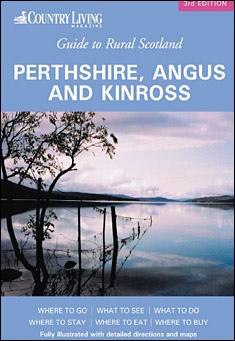
Perthshire, Angus and Kinross
Free ebook download: Perthshire, Angus and Kinross by UK Travel Guides , legally licensed and available in PDF format.
The two counties of Perthshire and Angus straddle the Highland Boundary Fault, which separates the Highlands from the Lowlands, while Kinross, once Scotland’s second smallest county, is wholly Lowland in character. So there is a wide variety of scenery within this area, from mountains, glens and lochs, to quiet, intensely cultivated fields and picturesque villages.
The two counties of Perthshire and Angus straddle the Highland Boundary Fault, which separates the Highlands from the Lowlands, while Kinross, once Scotland’s second smallest county, is wholly Lowland in character. So there is a wide variety of scenery within this area, from mountains, glens and lochs, to quiet, intensely cultivated fields and picturesque villages.
Perthshire is a wholly inland county, a place of agriculture, high hills and Highland lochs. It is the county of Loch Rannoch and Loch Tummel, and of possibly the loneliest railway station in Britain, Rannoch, deep within the bleak expanse of Rannoch Moor. It is also the county of the Gleneagles Hotel, one of Britain’s most luxurious, and of rich farmland surrounding Perth itself. Blairgowrie is the centre of Scotland’s fruit growing industry - and once supplied the Dundee jam makers.
The A9 from Perth heads north towards the Drumochter Pass, which reaches its highest point of 1505 feet at the Perthshire/ Inverness-shire border, overlooked by four Munros. On the way, it passes deeply wooded glens and skirts such historic towns and villages as Dunkeld, Pitlochry and Blair Atholl. In fact, Perthshire likes to call itself the Big Tree Country, as it has some of the most remarkable woodlands anywhere in Europe.
Perth is a city, and before local government reorganisation in the 1970s, had a lord provost, one of only six places in Scotland that could claim that distinction, the others being Edinburgh, Glasgow, Dundee, Aberdeen and Elgin. No legal document has ever specifically taken that honour away, so it remains a city still. It is often referred to as the Fair City of Perth, and this is no idle description. It may be in the Lowlands, but it was never scarred by the industrial developments of the 19th century. It remains a confident, attractive place with many fine buildings and a good quality of life.
Angus has a coastline that takes in high cliffs and sandy beaches. The coastal towns are famous. Carnoustie, where the British Open is sometimes held; Montrose and its almost land- locked basin where wildfowl can be seen; and of course Arbroath, with the ruins of an abbey where one of the momentous documents in Scottish history was signed - the Declaration of Arbroath. Inland, the countryside is gentle and pastoral, with the particularly beautiful glens of Angus, such as Glen Prosen, Glen Clova and Glen Doll, winding their way into the foothills of the Cairngorms.
Dundee is the area’s largest settlement, and the fourth largest city in Scotland. It sits on the north bank of the Firth of Tay and is a place of industry. At one time it was one of the powerhouses of Scotland, relying on its three traditional industries of jute, jam and journalism. But it is an ancient place as well, and its roots go deep into Scottish history. One of Scotland’s famous historical characters, John Graham of Claverhouse, adopted its name when he became 1st Viscount Dundee.
Kinross sits to the south east of Perthshire in a great saucer-shaped depression with, at its heart, Loch Leven. The main industry is farming, and the gentle countryside, ringed by hills, is well worth exploring. Loch Leven is famous for its fishing, and Vane Farm Nature Reserve was the first educational nature reserve in Europe.